Press Room

Press Clipping / Feb 25, 2021

Fire and evacuation drill at the pharmaceutical plant “Hovione”

News.Gov.MO, February 25, 2021

Fire and evacuation simulator at the pharmaceutical factory “Hovione” | Hovione


好利安藥廠火警疏散演習

Fire and evacuation simulator at the pharmaceutical factory “Hovione”


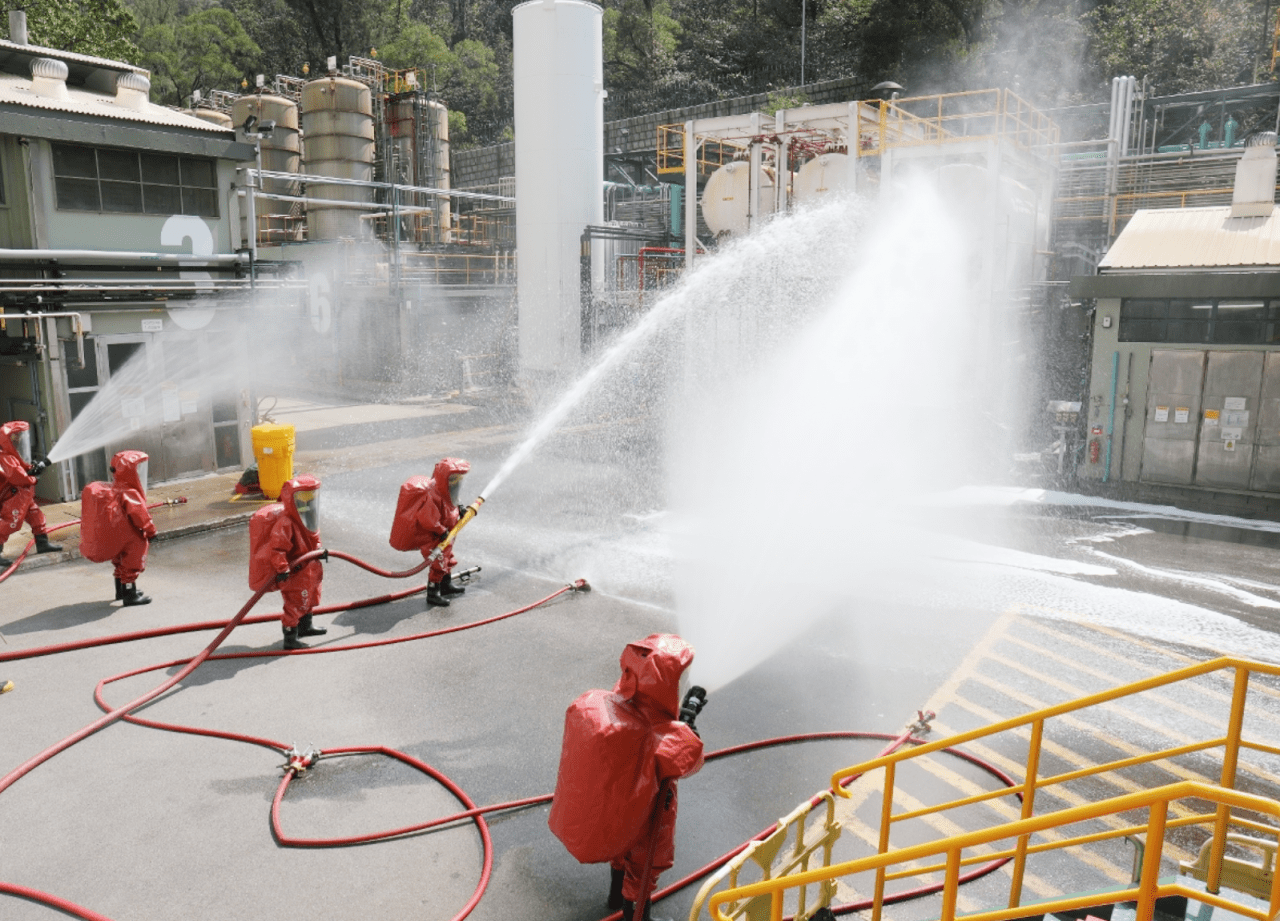
Firefighters fought the fire by the storage tank.

The Fire Brigade (CB) held on the morning of February 24th this year, a fire and evacuation simulator with dangerous chemical substances in the pharmaceutical factory “Hovione” together with Hovione FarmaCiencia SA, with the intention of intensifying the measures contingency and the coordination and communication mechanism between both parties in case of incidents.

The exercise simulated that a worker discovered that the leak occurred at the connection point of the methanol solution storage tank, thus causing a fire. The employee immediately sounded the fire alarm, the pharmaceutical factory's emergency and contingency team immediately proceeded to the internal contingency action, called the CB to ask for assistance and adopted security measures to evacuate the employees to the evacuation and meeting place. During the evacuation period, there was 1 worker who was injured. After becoming aware of the occurrence of a fire at the pharmaceutical factory “Hovione”, the CB immediately dispatched 9 emergency vehicles and 38 firefighters to the site to fight the fire, carry out the evacuation and search according to the defined plan, as well as provide nursing care for the injured and simulate transport to the hospital. The simulation lasted almost 1 hour.

CB and the pharmaceutical factory “Hovione” sent around 160 people to participate in the simulation, whose main purpose is to test the responsiveness and the communication mechanism between the relevant parties in case of incidents. The respective process went well, after the simulation, both parties held a review meeting, whose objectives and expected results were achieved.

[Translated from the original]


好利安藥廠火警疏散演習

為加強與好利安藥廠在發生事故時的應變措施及協調溝通機制,消防局於本年2月24日上午,與好利安製藥科學股份有限公司在氹仔好利安藥廠聯合舉行化學危險品火警及疏散演習。

演習模擬工作人員發現一個含有甲醇溶液的儲存缸接駁口出現洩漏並發生火警,工作人員隨即按動火警警報,藥廠緊急應變隊伍即時啟動內部應變計劃,同時致電消防局求助,以及採取安全措施疏散員工到逃生集合點,於疏散期間有一名員工不慎受傷。消防局接報好利安藥廠發生火警後,立即派遣9架緊急車輛及38名隊員趕赴現場,按照既定計劃進行滅火及疏散搜救行動,並對傷者進行即時護理及模擬送院,演習過程歷時約1小時。

消防局和好利安藥廠合共派出近160名人員參與是次演習,主要目的是測試發生事故時雙方的應變能力及溝通機制,演習過程順利,事後雙方進行檢討會議,並達到預期目的及效果。


Simulacro de incêndio e evacuação na fábrica farmacêutica “Hovione”

Os bombeiros combateram o fogo junto do tanque de armazenamento.

O Corpo de Bombeiros (CB) realizou na manhã do dia 24 de Fevereiro do corrente ano, um simulacro de incêndio e evacuação com substâncias químicas perigosas na fábrica farmacêutica “Hovione” em conjunto com a Hovione FarmaCiencia SA, com o intuito de intensificar as medidas de contingência e o mecanismo de coordenação e comunicação entre ambas as partes em caso de incidentes.

O exercício simulou que havia trabalhador que descobriu que ocorreu a fuga no ponto de ligação do tanque de armazenamento da solução de metanol, acontecendo assim um incêndio. O empregado tocou imediatamente o alarme de incêndio, a equipa de emergência e contingência da fábrica farmacêutica procedeu logo à acção de contingência interna, ligou ao CB para pedir auxílio e adoptou as medidas de segurança para evacuar os funcionários para o local de evacuação e encontro. Durante o período de evacuação, havia 1 trabalhador que ficou ferido. Depois de ter tido conhecimento da ocorrência de incêndio na fábrica farmacêutica “Hovione”, o CB enviou de imediato 9 veículos de emergência e 38 bombeiros ao local para combater o fogo, executar a acção de evacuação e busca conforme o plano definido, bem como prestar os cuidados de enfermagem junto do ferido e simular o transporte para o hospital. O simulacro durou quase 1 hora.

O CB e a fábrica farmacêutica “Hovione” enviaram cerca de 160 pessoas para participar no simulacro, cuja finalidade principal é testar a capacidade de resposta e o mecanismo de comunicação entre as partes pertinentes em caso de incidentes. O respectivo processo correu bem, depois do simulacro, ambas as partes procederam a uma reunião de revisão, cujos objectivos e resultados esperados foram alcançados.

 
Read the article at News.Gov.MO


Also in the Press Room

See All

The podcast "The Next Discovery" is a six-episode series created by Observador, a leading portuguese digital newspaper and radio station, in partnership with Hovione. And what if some of the scientific discoveries that can improve the lives of millions of people were happening right now in Portugal? The Next Discovery. Listen to the first episode of the podcast here, featuring Diane Villax, co-founder of Hovione. [English transcription] Welcome to The Next Discovery. This is a series of conversations, created in partnership between Observador Lab and Hovione, an international pharmaceutical company of Portuguese origin, that will open the doors to its world and share real stories of science, innovation and global impact. Over six episodes, we will meet the people behind technologies that help develop and manufacture innovative medicines for the world’s largest pharmaceutical companies that improve the lives of more than 80 million patients every year. I am Nelson Ferreira and, in this first episode, we will discover how an unlikely story, which began in a basement in Lisbon, became a story of global leadership. To talk about this legacy, I have the honour of welcoming Diane Villax, co-founder and non-executive board member of Hovione, who at the age of 91 remains a living witness to this journey. Nelson Ferreira (NF): Welcome, Mrs Diane Villax. Let us begin our conversation in 1959. Hovione was born in an unlikely way, in a basement in Lisbon, founded by your husband, Ivan Villax, by you and by two other partners. How did you manage family life and, at the same time, the birth of a pharmaceutical company, all in the same space? I imagine that created some interesting logistical challenges. Diane Villax (DV): From the beginning, we decided that we would manufacture raw materials for the pharmaceutical industry, that is, the active ingredients of medicines. We had no money, so it had to start from our home, which was in a residential neighborhood in Lisbon. Right from the start, we divided the tasks. My husband, a brilliant Hungarian chemical engineer, would be the inventor, the producer and the salesman, while I would take care of all the administrative side: imports, exports, accounting and banks. I kept those responsibilities for at least 30 years. At the same time, we also thought about the values that would guide us over this long period: transparency, innovation, the pursuit of excellence and great consideration for everyone who would come to work with us over the years. NF: Very early on, your husband made it clear that Hovione would not compete on low price, but rather on quality and on solving complex problems. What was it like to apply this principle of rigour when resources were still scarce? Especially because, from day one, it always seems to me that your objective was global. The world would be your market. DV: From the beginning, we felt that Portugal, with a population of 10 million people, would not be a very significant market, and that the world would be ours. Perhaps we were a little naïve, because we were entering a global market that was already quite sophisticated. But the decision was made and we moved forward. We moved forward and were fortunate that Japan discovered us quite quickly. They came knocking on our door, because of course we did not have the means to knock on theirs. At that time, they did not manufacture; they only formulated, so they needed to buy raw materials. My husband had invention patents for independent processes and there were long discussions. They felt that our technology was good, our IP was very robust and our quality was excellent. This led to a cooperation that lasted 10 or 15 years and was very profitable for both sides, I believe. NF: In the 1980s and 1990s, Hovione took a more significant leap forward. What were the decisions, the technological bets or even the moments of greatest courage that allowed this small Portuguese company to become a leading multinational? DV: In 1982, after a successful inspection by the FDA, the regulatory authority in the United States of America, we entered the American market with our generic doxycycline antibiotic. The inventor’s patent had already expired and we had an independent manufacturing process. It was a huge, demanding and competitive market, but one that respects good service and quality. And it was indeed a major leap, because the market was so large that we had no real sense of what it would mean, and demand was much greater than what we were able to produce. I remember, it must have been the summer of 1983, many people probably had to postpone their holidays to the autumn or winter, because missing delivery deadlines was not an option. Later, in the 1990s, we entered a new business area: services. We realized that large American pharmaceutical companies, as well as small biotechs, were increasingly inclined to outsource the development work for new molecules. This is a very long period, which can take four, six or even 10 years — the development process for new molecules before they are approved by regulators and become commercial products. So we began to offer this development service, and it went very well. From there, we developed new technologies, such as spray drying, for poorly soluble molecules, because this could greatly increase their bioavailability. Today, this services area is our largest business segment. NF: Hovione today works with 19 of the world’s 20 largest pharmaceutical companies. How do you maintain the agile, pioneering spirit that was born in that basement, when today the company has 2,600 employees, more than 300 scientists, and has even become the largest private employer of PhDs in Portugal? DV: Agility has to be maintained. For example, during the pandemic, we suddenly received large, unexpected orders to manufacture a component of Remdesivir, which was the product authorized to help Covid patients. So agility has to be maintained, and we always maintain our quality. Today, with more than 60 years of history, clients come to us because they know they can count on our quality and on our responsibility to produce and deliver on time what they order. NF: There is another impressive figure here. Your products reach 80 million people every year and Hovione participates in up to 10% of the new medicines approved annually by the FDA in the United States. When you look at this impact, do you feel that the dream of 1959 has been fully achieved? DV: I think it has been far exceeded. When we founded Hovione, my husband, who was a scientist, simply wanted to have his own laboratory. But he never imagined that we would develop in such a way that, today, we are sought out by major international pharmaceutical companies, which frequently come to us. NF: This is a series about science, but it is also about people. And the rigour, ethics and long-term vision that Diane always brought to management are still present at Hovione. What message would you leave to the scientists who join Hovione today with the mission of finding the next discovery? From what I understand, Diane makes a point of welcoming them whenever they join the company. DV: Yes. Four times a year, twice in English and twice in Portuguese, I speak to the newcomers at Hovione, giving them a very brief account of our journey, our values, our objectives, our dreams, the challenges we faced and how we overcame them to get to where we are today. And I always recommend that anyone who joins this company must work with passion. They must work with passion and always remember that our work is to produce medicines for those who need them. We have the privilege of serving patients. We are a company that works for society. I think “In it for life”, which is our motto, has a lot to do with us, because we have been here for 67 years as a family company, and that is how we intend to continue for many good years to come. Above all, in the healthcare sector, there is a great advantage, because we can look at the long term. We do not have to think about stock market results every quarter, as public companies do. And, on the other hand, we are here precisely to give life to those who need it. “In it for life.” NF: At the age of 91, how does Diane herself maintain this passion and continue to make long-term plans? DV: Because I was a founder of this company. I see it progressing and developing successfully, so it is a joy for me. And I have a large family coming after me. I have six grandchildren and seven great-grandchildren, and I hope to leave the company to them so that they can continue it as I managed it. NF: That is truly inspiring. Mrs Diane Villax, thank you very much for sharing the memories and inspiration of this legacy, which remains very much alive. It was a privilege. This was the first chapter of The Next Discovery. In the coming weeks, we will continue to open the doors of Hovione to discover how Portuguese talent is leading the world, from complex chemistry to particle engineering, from respiratory therapies to next-generation biological medicines.   You can listen to the next episodes on observador.pt and on your usual podcast platform.    

Article

Podcast “The Next Discovery” (EP1) - From a basement in Lisbon to global impact

Jun 18, 2026

Hovione is bringing momentum to the intranasal field after announcing that its lead single-use nasal dry powder device, developed in collaboration with Industrial Design Consultancy Ltd (IDC), is now available for commercial partnerships. The milestone marks the transition from prototype to a fully integrated intranasal drug delivery platform that spans Hovione’s end-to-end partnership capabilities–from API synthesis through advanced formulation and particle engineering to drug product manufacturing, including device supply and advanced analytical tools for nasal performance characterization. The platform’s single-use device is designed to be manufacturable at scale and to leverage existing advanced particle engineering and drug product manufacturing capabilities, a practical advantage that can shorten timelines to clinic and commercialization while reducing development risk and cost. The device’s patented mechanism supports targeted nasal deposition, including access to the upper olfactory region. This enables rapid systemic absorption and potential nose-to-brain delivery pathways that are increasingly important for CNS and emergency-use indications. Beyond the single-use format, Hovione and IDC are advancing a multi-dose variant to broaden applicability across dosing regimens and therapeutic areas. The collaboration is backed by an intellectual property portfolio and initial patent grants, positioning the platform as a turnkey option for pharma partners seeking a single integrated supplier for both drug substance and device. This development arrives as intranasal delivery gains traction for systemic, CNS and rapid-onset therapies. This is precisely the focus of the upcoming 4th Nasal Formulation & Delivery Summit, for which Hovione is a key sponsor. The annual summit unites formulation, delivery and product development leaders to tackle drug-device compatibility, translational preclinical models, and strategies for scalable, regulatory-ready intranasal programs. Hovione’s recent progress will be highly relevant to attendees looking to de-risk nose-to-brain and systemic intranasal programs. Read the full article at News-Medical.net    

Press Clipping

Hovione advances intranasal drug delivery with commercial-ready dry powder platform ahead of 4th Nasal Formulation & Delivery Summit

Jun 01, 2026